CHSU Overdose Prevention Committee Trains Buchanan High School Students to Effectively Respond to Opioid Overdose Through Hands-On Workshop
March 6, 2026
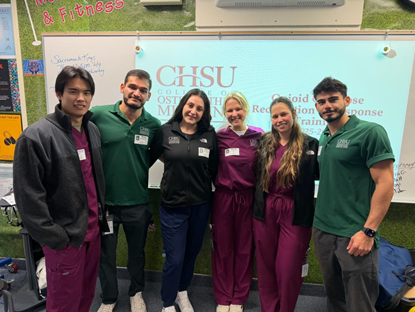
Photo caption from left to right: Eric Liu (Class 2028, Volunteer), Arshia Mohseni (Class 2028, Volunteer), Ashley Okhovat (Class 2028, Volunteer), Noa Gorgas (Class 2028, OPC Board Member), Eden Chelouche (Class 2028, Volunteer), Bardia Mohseni (Class 2028, Volunteer)
Written by Noa Gorgas, CHSU-COM Class of 2028, Overdose Prevention Committee Community Outreach Subchair
On Friday, February 20, 2026, the California Health Sciences University Overdose Prevention Committee’s (OPC) community outreach team hosted an off-campus opioid overdose and naloxone (Narcan) training workshop at Buchanan High School in Clovis. The session was held for students enrolled in the health science elective, a course designed to better prepare students for careers in healthcare.
Six CHSU-COM student doctors provided an in-depth presentation to the high school students, focusing on the pharmacology of opioids, signs and symptoms of an opioid overdose, and steps to respond to an opioid overdose.
The presentation also sought to destigmatize conversations surrounding opioid use and provide resources to help prevent overdoses through the discussion and distribution of fentanyl test strips. Fentanyl is a synthetic opioid that is extremely dangerous, because very small amounts can suppress breathing and cause cardiac arrest. Fentanyl test strips are used to detect the presence of unknown fentanyl in drugs before consumption and serve as an important harm‑reduction tool.
According to the National Institutes of Health (NIH), although overall drug use among adolescents has declined, mortality has increased due to the rising availability of counterfeit pills containing fentanyl, which is now involved in approximately 75% of adolescent overdose deaths. Distributing fentanyl test strips is just one of the many harm-reduction strategies OPC implements.
Following the didactic session, Buchanan High School students were divided into small groups to demonstrate their newly developed skills by administering intranasal naloxone to a medical manikin during a simulated opioid overdose scenario. said,
“It was incredibly rewarding to engage with high school students and provide hands-on education about harm reduction,”
– Eden Chelouche, second-year CHSU-COM medical student.
OPC’s goal is for this training to be a valuable resource for high school students as they prepare to transition into post-graduate life or college. Through their trainings, OPC helps equip community members with practical knowledge that can save lives and promote informed decision-making.