Ready to Save Lives: Overdose Prevention Committee Brings Opioid Overdose Training to Visalia
May 11, 2026
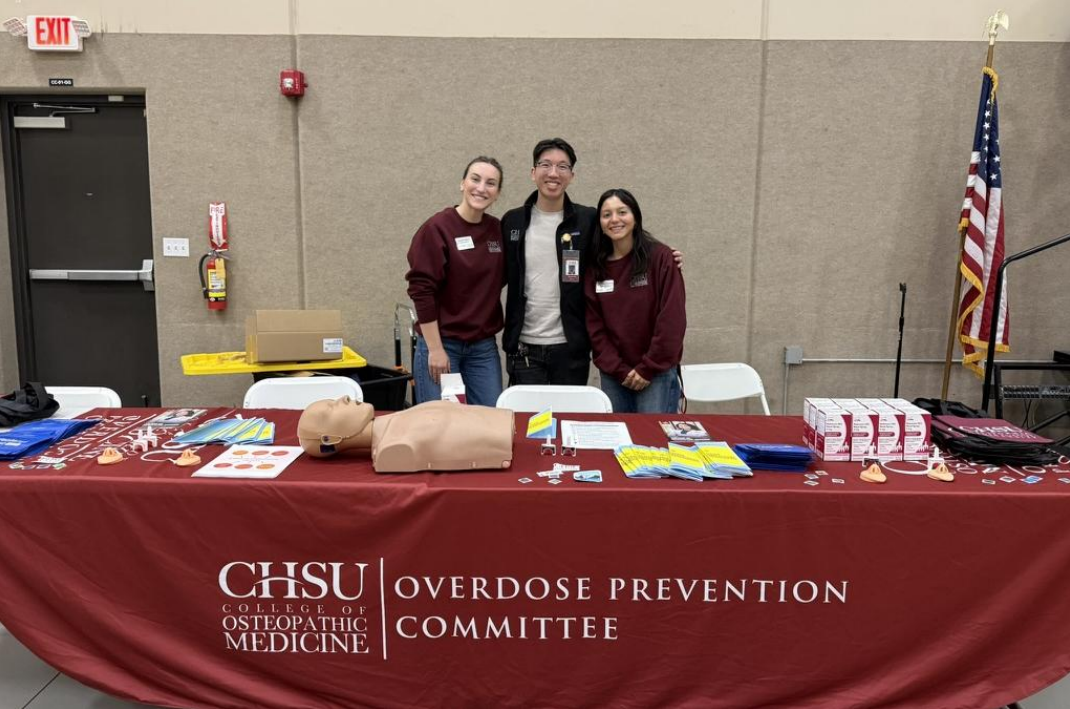
Photo caption Left to right: incoming OPC sub-chairs Natalie Boone (External Education), Theodore Do (Academic Outreach), and Esmeralda Menjivar (Community Outreach)
Written by Esmeralda Menjivar, OMS-I, OPC Community Outreach Sub-Chair
On Saturday, May 9, 2026, the incoming Overdose Prevention Committee (OPC) at California Health Sciences University College of Osteopathic Medicine (CHSU-COM) hosted its first opioid overdose and naloxone training at the Central Valley Health Fair, organized by the MiMentor Fresno State chapter. More than a dozen of Visalia community members, many of whom shared they were in recovery or surrounded by opioid users, were trained on how to identify an opioid overdose and properly administer intranasal naloxone.
The event was supported by incoming OPC sub-chairs Esmeralda Menjivar (Community Outreach), Natalie Boone (External Education), and Theodore Do (Academic Outreach), alongside current OPC External Education Sub-Chair, Abigail Grigoryan (OMS-II). Education was provided on recognizing the signs and symptoms of an opioid overdose, identifying the common sources of opioids, and understanding the importance of contacting emergency medical services after naloxone administration, as its effect may be temporary.
To reinforce the education, community members were trained on how to properly administer intranasal naloxone on OPC’s manikin, Anikin. Attendees were provided with free intranasal naloxone to take with them for use in case of an emergency.
To support harm reduction efforts, OPC also trained community members on how to use fentanyl test strips to detect potentially laced substances before they are consumed. While naloxone remains the essential emergency intervention to reverse the effects of an opioid overdose after it occurs, fentanyl test strips serve as a preventative tool to help reduce accidental ingestions and overdoses before they happen.
The opioid crisis affects all of California, but the Central Valley has been hit with particularly devastating force, experiencing some of the highest rates in the state. OPC’s recent mission to Visalia was driven by the urgent need to address the rising prevalence of opioid overdoses in the community. By showing up, OPC aimed to transform awareness into tangible, life-saving actions for our neighbors. In a region where these tragedies have become all too common, providing direct access to resources and education isn’t just a community service; it is a critical intervention designed to protect the families and individuals who call the Valley home.
OPC believes the best way to combat the opioid crisis is through localized, judgment-free support that empowers residents with the tools to save lives. By bridging the gap between medical knowledge and community needs, OPC is working to turn the tide on the epidemic and build a safer, more resilient future for everyone in the Central Valley.