Overdose Prevention Committee Takes the National Stage at AACOM, Highlighting Student-Led Naloxone Training Initiatives
April 27, 2026
Written by Aarti Dixit, CHSU-COM Class of 2028, Overdose Prevention Committee Research Sub-Chair
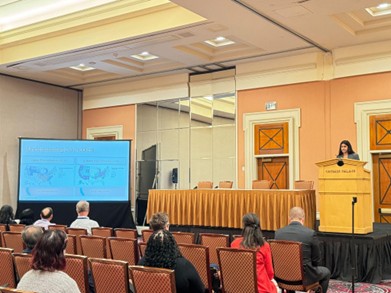
On April 23, 2026, Aarti Dixit, Overdose Prevention Committee (OPC) Research Sub-Chair, represented OPC and California Health Sciences University College of Osteopathic Medicine (CHSU-COM) at the American Association of Colleges of Osteopathic Medicine (AACOM) national conference in Las Vegas, NV, delivering an oral presentation titled, “A Scalable, Student-Led Model for Naloxone Training in Medical Education.”
In response to the increasing rates of opioid overdose deaths, the Student Osteopathic Medical Association (SOMA) established a framework in 2019 to guide the development of Overdose Prevention Committees at osteopathic medical schools. In 2022, CHSU-COM launched its own OPC chapter, initially led by a small group of students without formal infrastructure. As OPC’s presence and contributions grew, members identified the need for structured leadership and faculty mentorship to ensure sustainable development.
Under the guidance of their faculty advisor, an emergency medicine clinical pharmacist experienced in naloxone distribution and community partnerships, OPC developed a subcommittee-based model to streamline operations. This approach enhanced professionalism, scalability, and long-term sustainability within the organization. During the AACOM presentation, OPC’s model was discussed in detail to serve as a reference for other schools seeking to establish or refine their own programs.
During the 2025–2026 academic year, OPC advanced its impact by implementing a formal evaluation of its training program within the OMS-I curriculum. Opioid overdose response training was successfully integrated as a required component of the clinical curriculum, alongside Basic Life Support (BLS) and Stop the Bleed Training, both of which are led by clinical faculty, whereas the opioid overdose response training is facilitated by OPC student board members. The opioid overdose response training included a didactic session, hands-on skills assessment, and pre- and post-surveys to evaluate student learning outcomes. Results demonstrated a statistically significant increase in student knowledge and confidence regarding opioid overdose recognition, naloxone administration, and harm-reduction principles.
At AACOM, Aarti Dixit demonstrated how CHSU-COM OPC transformed the traditional committee model into a scalable, student-driven initiative. By incorporating a “train-the-trainer” approach, OPC has expanded its educational reach to medical students and the wider Fresno community, thereby amplifying its impact on overdose prevention and public health awareness. Beyond education, OPC’s outreach has strengthened CHSU-COM’s role as a trusted resource in the Central Valley, supporting its emergence as a new medical school. OPC encourages other medical schools to adopt a similar framework, empowering students to implement sustainable, student-led overdose prevention programs for future physicians.